
I Used to Present Three Brand Concepts. Here’s Why I Stopped.
The One Concept Method: what it is, why I’ve been slow to fully commit, and why I’m all in now.
I have been side-eyeing the One Concept Method for a while now. Years, even. I’d read about it, talk myself into it, talk myself back out of it, and then go back to presenting two or three concepts per project like I always had. I was defaulting to the safe route, the expected route, the “clients expect options” route…
And then I’d watch a client pick the wild card—that’s what I started calling it, at least. The third concept. The one that came out of the research instead of the brief. The one I personally believed would serve her business and her future clients better, but was almost nervous to show because it pushed further than what she asked for.
Every. Single. Time.
I’d bring in two concepts that were polished, professional, and aligned with exactly what the client told me she wanted. And then there was the wild card. She picked it. The next client picked hers. And the one after that. And I kept filing this pattern away in the back of my brain going, hmm, and then continuing to present three options anyway. (Classic Shannon. Knowing something and not quite acting on it yet. We’ll get into that.)
Here’s what I’ve recently come to terms with: I was scared. Not of the method itself, but of what committing to it meant. It meant trusting my own expertise enough to say, “This is the answer,” without a backup plan behind me. That’s a different level of professional vulnerability than I was used to putting on the table.
But I’m fully in now. And I want to tell you why—and what it means for you if you’re thinking about working with Sunday Muse.
Which, by the way, if you’re thinking about working with me, here’s what it’s like when you become a client!
First: What even is the One Concept Method?
Great question, hypothetical reader who asked at the perfect time 😏
The industry standard for brand identity design has traditionally been to present three to six concepts and let the client choose their favorite. The One Concept Method is exactly what it sounds like: instead of options, the designer presents one singular, fully developed, strategically grounded concept.
One direction. Fully committed. No hedging.
Before you spiral into “but what if I hate it”—stay with me. Because that’s not how this works, and I promise by the end of this post it’ll make a lot of sense.
The key thing to understand is that presenting one concept doesn’t mean the designer only had one idea. It means she had many ideas, explored them thoroughly, let the research and strategy lead, and made an informed professional call about which direction is the best one before you ever see anything. Think of it as a designer doing her homework so thoroughly that the answer becomes clear. The scratch paper stays on my desk.
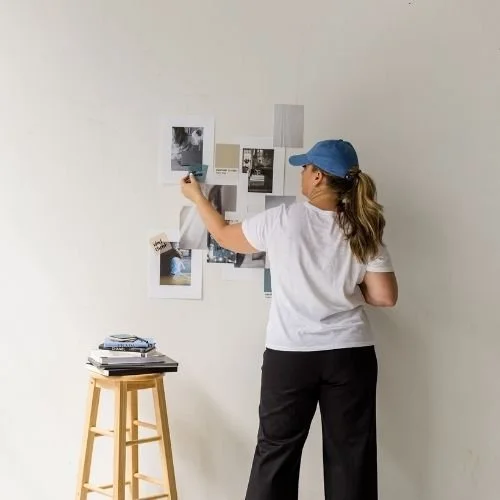
Why multiple brand concepts sound good but aren’t
I get why options feel generous. More = more value, right? I thought so too, for a long time. Here’s what was happening in my projects.
The work got diluted.
Every hour I spent developing a second or third concept was an hour I wasn’t spending on the strongest one. Three decent concepts instead of one exceptional one. And here’s the part that made me a little sick to think about: I always knew which one was the strongest. I was just also presenting the other two. For what? For the illusion of generosity? Yikes.
It turned strategic decision-making into a vibe check.
The moment multiple options land in front of someone, the question becomes “which one do I like?” That is the wrong question for a brand identity. The right question is: which one will resonate with your ideal clients, position you where you want to go, and hold up as your business grows?
Those are very different questions. When there are three concepts on the table, it is almost impossible not to answer the first one. I watched it happen constantly.
Hello, Frankenstein.
We’ve all been there (or seen it). “I love the color palette from option one, the logo mark from option two, and the font from option three.” Sounds reasonable! Feels collaborative! Produces a brand identity that is internally inconsistent, stitched together from pieces that were never designed to coexist, and looks less like a strategic brand and more like a mood board had a minor breakdown.
It put the most important decision in the wrong hands.
You hired a brand designer because you needed someone with expertise in visual strategy. Presenting three concepts and asking you to choose is, in a roundabout way, outsourcing the most critical creative decision back to you. That’s not a service. That’s a very pretty deferral.
So why did it take me so long to fully commit?
This is the part where I get a little honest with you.
Intellectually, I’ve known for a while that the One Concept Method made more sense. The pattern in my own client work was staring me in the face. The designers I most respected were already doing it. The logic was airtight.
Committing to it fully meant something that felt a little terrifying: standing completely behind one answer, with no safety net. No “if she doesn’t love this one, there’s always that one.” Just… this is it. This is what I believe is right for your brand. Full stop.
The transition also takes recalibrating how clients understand the process before they ever get to that presentation. You can’t just spring it on someone. The setup matters enormously.
I’ve been doing the setup. Refining how I communicate the strategy phase, how I walk clients through the research, how I build the kind of shared foundation that makes one concept feel inevitable rather than risky.
And now that I’m here, it feels like the version of my process I was always building toward.
How it works at Sunday Muse
Presenting one concept doesn’t mean winging it and crossing my fingers. It means front-loading the work so that by the time a concept reaches you, it’s already been through serious exploration and refinement.
We build strategy before anyone touches a single design element.
Your audience. Your competitors. Your positioning. The language your ideal clients use when they’re searching for someone like you. Where you’ve been and, more importantly, where you’re going. All of it feeds into a brand strategy that becomes the filter for every design decision that follows. That foundation is what makes one concept work—by the time design begins, the direction has already been earned.
The exploration happens on my side of the wall.
I sketch a lot of things that don’t make it. I follow directions that feel interesting and then hit a dead end and turn around. That process is real and it’s necessary. Getting to the right answer requires taking all the wrong turns first—and that’s my job, not yours.
The concept arrives with the full story.
When I present the concept, I don’t just show you the logo and go “so… thoughts?” I walk you through the reasoning behind every decision: the color palette, the type, the mark, the feel—all tied back to the strategy we built together. The goal of that presentation is to help you see your brand through your clients’ eyes, not to evaluate it based on your own taste.
Revisions are still part of the deal.
One concept doesn’t mean take it or leave it. Revision rounds are built in. The difference is that we’re refining a direction we’ve both already committed to strategically, rather than looping back to relitigate which direction to go. That distinction is everything. Projects move forward instead of going in circles.

What this means for you
A few things I want you to know going in.
You get my full creative attention on one thing, not a third of it on three.
Every creative hour I have goes into the concept you see. When you open that presentation, you’re seeing work I’ve poured everything into. That’s a different experience than receiving the strongest of three options, where the other two took hours that could have gone into pushing the best idea further.
You skip the spiral.
Have you ever been to a restaurant with a twelve-page menu and spent fifteen minutes reading it, only to order the thing you almost ordered on page one? Multiple brand concepts do something similar. You end up spending an enormous amount of mental energy on a decision you’re not equipped to make objectively because you’re looking at it with your eyes, not your clients’.
One strong concept removes that spiral entirely.
The brand holds together better.
A brand identity designed as one unified concept—where every element was built to work with every other element—coheres differently than one assembled from pieces of multiple concepts. The integrity is baked in from the start.
It requires trust. And I don’t take that lightly.
The One Concept Method works because of the strategy foundation we build together before design begins. It works because of the collaborative process that happens before a single pixel gets placed. And it works because you’re willing to trust that when I show up with an answer, I’ve done the work to earn it.
In return, what you get is a designer who is fully committed to your brand…standing behind one direction because she believes it’s the right one.
Back to the Wild Card
I called it the wild card because it felt like one at the time. It pushed past what the client asked for. It was rooted in what the research said, not what the brief said. It was the concept I believed in most and was most nervous to show.
My clients kept choosing it not because it was surprising, but because (once I walked them through the reasoning) it was obviously right. The strategy was undeniable. The intention was visible. They could feel it.
The wild card was never actually wild. It was just the one I’d given the most thought to.
The One Concept Method is me formalizing what I’d already learned, one project at a time: stop hedging. Do the work. Present the best answer. Trust the process—and trust yourself.
Took me longer than I’d like to admit to get fully here. But I’m here. And I’m not going back.

If you’re looking for a brand that feels like it was made specifically for where your business is headed—by someone who’s going to show up with a real answer and the receipts to back it up—I’d love to hear what you’re working on.