
What SEO Research Changes About Your Brand and Website

I would like to formally release SEO from the tiny little box labeled “stuff we do so Google likes the website.”
Because SEO influences way more of my work than choosing a keyword and figuring out how to gracefully work it into a sentence without making everyone involved uncomfortable.
I use SEO research while I’m figuring out how a website should be organized. I use it to understand how people talk about a service when the business owner isn’t in the room to explain it. I use it when I’m researching competitors and trying to figure out why 9 businesses in the same industry have apparently agreed to say the exact same thing.
And increasingly, I’m thinking about all of this through AEO, too, because people are searching differently now.
Google is still very much Google-ing. But people are also opening ChatGPT and asking:
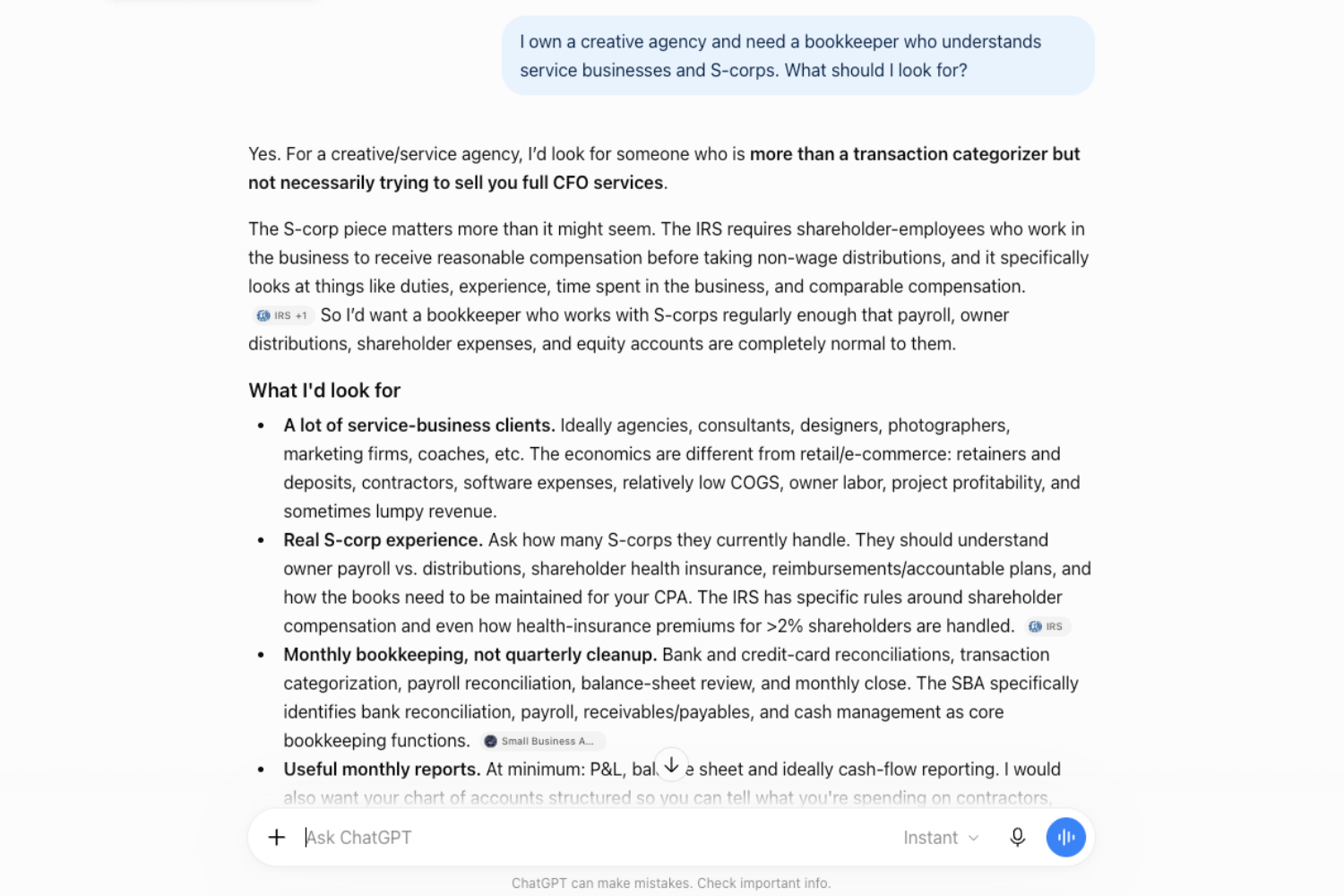
“Find me a bookkeeper who works with small creative agencies and can help me clean up my books before I switch to an S-corp.” or
“I own a small business in South Carolina and need an attorney to review my client contract. Who specializes in working with service-based businesses?” or
Or, yes, “Who are the best wedding florists in Greenville for an editorial wedding?” or
That’s a lot more information than “bookkeeper near me” or “small business attorney.” And it gives search another job: understanding enough about your business to know when you belong in the answer.
Which means I have some new questions to consider when I build a website.
Can Google figure out what you do?
Can ChatGPT or Claude or Gemini or whatever-AI-tool-of-the-month there is?
Can a person who was referred to you by her friend Sarah at Pilates?
Ideally, the robots are all coming back with roughly the same idea about who you are and when someone should hire you.
SEO research is customer research wearing a slightly nerdier outfit.
Keyword research sounds very spreadsheet-y because, to be fair, there is usually a spreadsheet 🤓
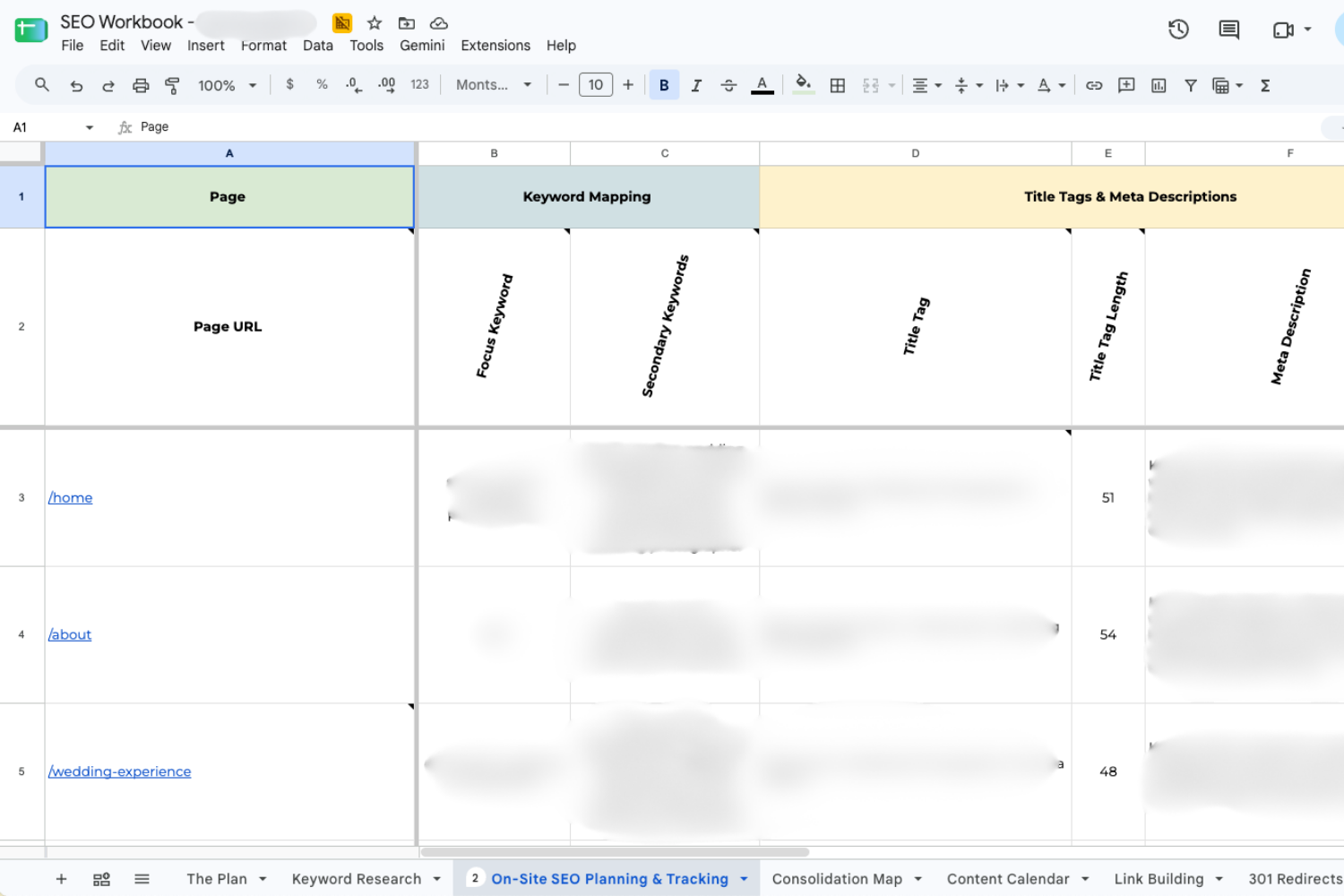
But every search in there came from a person trying to solve something.
That’s the part I’m nosy about… the words people type into Google can tell me how they describe a service before they’ve learned all the language we use inside the industry. Once I start digging around, I can see where demand is concentrated, which questions keep sending people down a search rabbit hole, and whether your competitors have already covered a subject to death.
I’ve also found services buried halfway down a page that people are specifically searching for on their own. That changes how I think about the website. If people are going looking for that service by name, I want to seriously consider whether it deserves a real page instead of three sentences and a button.
Then there are the searches where I open ten competitor websites and realize everyone has written some version of the same website. I LOVE finding that because now I can see exactly what your buyer has been staring at before she gets to you. We have context for what will feel familiar, what has become category wallpaper, and where you have room to be more specific.
SEO research gives me a peek at the neighborhood before I build the house.
(I know. I said SEO and then made it about branding again. Shocking.)
👉 I’ve written before about what your SEO can reveal about your brand strategy, and this is another side of the conversation: what SEO research can tell us before I start making decisions about your brand and website.
This can change the website I recommend.
SEO is something I consider while I’m figuring out what your project needs. I don’t automatically tack advanced SEO onto every website because every business does not need the same scope.
But there are projects where I get into the research and realize we would be leaving a real opportunity on the table if we built the website without it. That’s when I’m going to tell you I think SEO belongs in the project and explain what I’m seeing.
The research can also change decisions I haven’t made yet. Say you come to me with three services living together on one Services page, because that’s how the website has been organized for years. Then I discover that one of them has its own search demand, its own set of questions, and a buyer who is looking for it specifically. I’m going to reconsider the sitemap.
Or I might find that your industry has adopted language your audience rarely searches, which gives us something to think about before we write a single headline. Competitor research can send me in another direction entirely: I’ll stumble into an area where you have a ton of experience, realize nobody is saying much of substance about it, and text you, “Okay wait, I found something.”
That’s what I mean when I say SEO belongs in strategy. The research changes decisions I’m making about the brand and website.
And now people are asking AI to do the searching for them.
This is where AEO enters the chat.
AEO stands for Answer Engine Optimization. You will also see GEO, AI SEO, AI visibility, and probably six more terms by the time I publish this because everyone on the internet is currently trying to win custody of the acronym.
I’m going to spare both of us that debate.
Here’s what I care about:
People are asking AI tools questions about what to buy and who to hire.
And those questions can get incredibly specific.
Someone might type “Charleston wedding photographer” into Google.
In ChatGPT, she can say:
I’m getting married in Charleston next May. I want a photographer whose work feels editorial but still candid, and I really care about skin tones looking natural. Who should I look at?
That is a very different search.
There is so much information packed into that question about what she values, how she sees herself, and what she needs in order to consider someone relevant.
Now imagine what an AI system has to figure out before it can recommend a business.
Where are you?
What do you do?
Who do you work with?
What are you especially good at?
Do you have evidence of that?
Does the rest of the internet seem to agree?
Have you given it enough useful information to associate your business with the things you want to be known for?
This is where branding, messaging, SEO, content, PR, reviews, and AEO start bumping into each other in ways I find VERY interesting.
Your brand has to be understandable when you’re not there to explain it.
This is probably the simplest way I can explain how I think about AEO.
You know everything about your business because you live inside it.
Google does not.
ChatGPT does not.
Claude does not.
The person who heard about you in a group text definitely does not.
They’re piecing you together from what they can find.
So when your website clearly says where you work and what you specialize in, that information has somewhere to come from. The project page where you explain what you did gives the internet more context than one beautiful gallery with a caption that says “still not over this one 🤍.” Your reviews, interviews, press, directory listings, blog posts, portfolio pages, and other mentions start filling in more of the picture.
Because “we provide bespoke experiences tailored to each unique client” is technically a sentence, but I am begging businesses everywhere to give the internet more to work with.
This is the part of AEO that makes sense to me as a brand strategist: if I want the internet to understand something about your business, I want to give it some damn good evidence.
This is one reason I still believe in blogging.
Yes. Blogging.
In the year of our Lord 2026.
I know Instagram is shinier.
But a good blog gives you somewhere to put your expertise where it can keep working longer than 24 hours.
The question you’ve answered for clients approximately 400 times can become the article someone finds six months from now at 11:47 p.m.
A project can become a case study where you explain the decisions behind the pretty pictures.
And the opinions you’ve developed after ten years of doing this work finally exist somewhere besides your head and a handful of Instagram Stories.
That body of work helps a potential client get to know how you think.
And now there’s another possibility: some of that information can help AI systems understand what your business knows about.
That gets my attention.
If I want Sunday Muse associated with branding, website strategy, SEO, buyer psychology, and building brands that age well, I need enough substance online to support those associations.
I cannot put “brand strategist” in my Instagram bio and expect the entire internet to simply take my word for it.
Would be convenient, though.
SEO also shows me what everyone else is doing.
This may be my favorite part.
I love competitor research because I am nosy professionally.
I want to know what your industry looks like from your buyer’s side of the screen.
Once I start researching an industry, I usually end up with an unreasonable number of tabs open. After a while, I start seeing the same promises, service structures, headlines, portfolio conventions, and blog topics repeat themselves. I can also see where the search results are strangely thin—especially when I know my client has years of experience with something nobody else seems to be explaining very well.
That tells me considerably more than noting that Competitor A uses blue and Competitor B has a serif font. I’m starting to understand what your buyer has already been taught to expect from businesses like yours, where the industry has become repetitive, and what you bring to the table that has barely made it onto the internet yet.
And all of that context comes into the brand strategy with me.
Those discoveries influence how I think about your brand because good design has a reason.
I want to know the environment your brand has to work in.
Your homepage also isn't always the front door.
This is another thing SEO changes about the way I design websites.
You know your homepage? The page we will lovingly obsess over for weeks?
Plenty of people will skip it entirely.
They’ll meet you through the blog post that ranked.
Or a service page.
Or a portfolio gallery.
Or Google Images.
Or a link someone sent them.
Or, increasingly, an AI answer that mentions you and sends them directly to the page it cited.
So I think about those pages as introductions, too.
If someone’s first encounter with your business is a blog post you wrote two years ago, I still want her to know whose website she’s on. I want it to be obvious what you know, what you do, and where she should go if she wants more.
That is SEO work.
It is also brand work.
Funny how often that keeps happening 👀
This is what I mean when I say SEO is part of brand strategy.
I’m still doing the technical SEO work when a project calls for it: keywords, headings, metadata, image optimization, indexing, Search Console—all of that has a job.
I’m just much more interested in what the research tells me before we get there.
Search gives me another way to look at the market around your business. I can see how people are looking for what you sell, what language has taken over the industry, where your competitors are already strong, and where your experience gives us something worth building around. Now AEO adds another layer because we also have to consider what AI systems can confidently understand about you from the information available online.
That can change the website I build. It can change what we emphasize in the brand. It can give us an idea for an article I immediately need you to write because I cannot believe nobody has written it yet.
And yes, eventually I will write the meta description.
But by then, SEO has already done a hell of a lot more for the brand than help me fill in a title tag.