
A few weeks ago I was scrolling Instagram, half-watching a show I'd already seen. I landed on a wedding photographer's account. She had beautiful work. I kept scrolling, the way you do when you're avoiding the dishes.
The next account was also a wedding photographer. Also beautiful.
Somewhere around the fourth one, I realized I couldn't tell any of them apart.
They all had the same warm-neutral palette with the same skinny serif logo and the same "capturing your love story" energy in their bio. They all even had the same little olive branch graphic. Like they got it in a group text I wasn't on.
I had four tabs open and they were, basically, one brand wearing four names.
Then I started seeing it everywhere. The interior designers all do the same moody, lowercase, expensive-looking thing. The personal stylists all post the same beige flatlay. The attorneys all use navy-and-gold and a stock photo of a fountain pen. The e-commerce shops all copy whatever their competitor did eight months ago. Everyone in every field has drifted toward one look. And most of them have no idea it happened.
This is the thing nobody warns you about when you finally take your brand seriously. You go looking for inspiration. You study the people doing well. And you end up blending right into the crowd you wanted to stand out from. Some of those photographers are incredible at what they do. The problem is what they're all looking at. The good news is that it's fixable, just not the way most people try to fix it.
Why Everyone in Your Industry Ends Up Looking Alike
Here's what happens, and honestly, it makes total sense…
You start a business. You want it to look professional and credible, like it belongs. So you do the responsible thing and study what credible looks like in your field. All the photographers use that creamy oat-milk palette, so that must be what a high-end photographer looks like. All the interior designers talk in hushed lowercase, so that must be how a serious designer sounds. You're just picking up the cues that say you're one of the good ones.
The catch is that everyone in your industry is doing this at the same time. And the thing they're all studying is each other. Everyone copies everyone. Everyone picks up the same cues. And the whole industry slowly slides toward one look. A little of this actually helps you. People do need a signal that you're in the right business. Too much of it, and you're just camouflaging.
The cruel part is that the better the people at the top are, the harder it pulls. Say the best photographer you follow uses a certain font. That font starts to feel like quality itself. You reach for it before you even notice you did. You think you're chasing good taste. You've just inherited someone else's homework.
I see this all the time with the people I work with, and I want to be clear about who they are. They run established businesses. They have momentum, full client rosters, and revenue they're proud of. They did everything right. They studied the field, hired well, made smart choices. And they ended up with a brand that's genuinely nice. So nice that it looks like the eleven other nice brands their dream client is comparing them to. The brand is lovely. It just isn't really theirs.
What "Blending In" Is Costing You
"You look like everyone else" sounds like a vanity thing, right up until it costs you money.
When your brand blends in, your dream client has one thing left to decide between you and the next person: price. You wanted her to go with her gut, and instead you handed her a spreadsheet. And the gut is where the good stuff lives. It's where loyalty comes from. It's where referrals come from. It's where she says "I don't care what it costs, I want to work with HER."
Blending in also makes your marketing work twice as hard for half the payoff. Your reader has seen something just like your post forty times this week. So every post, every email, every pitch has to dig out of that hole first. A brand that stands out gets a different reaction. It gets a "wait, who is this?" That's the reaction you want.
I think about my own email list here. I once told my subscribers, flat out, that they could unsubscribe if my emails weren't for them. A handful did. I didn't lose a second of sleep over it. You can only do that when your brand is specific enough to push the wrong people away and pull the right ones closer. A brand that looks like everyone else can't push anyone away. There's nothing there to react to. It just sits there being pleasant. And pleasant is not a business strategy.
The Answer Isn't a New Color Palette
This is where most people go wrong, so I want to slow down.
When an interior designer realizes she blends in, her first instinct is to change how things look. She picks a new palette, swaps the font, books a moody photoshoot. She rearranges the furniture and hopes the room feels different. And for about three weeks, it does. Then she opens Instagram. Her brave new burgundy is now everyone's burgundy. Trends move through an industry like a yawn through a meeting.
A new palette won't fix this, because the sameness was never about the palette. You'll keep looking like your industry for as long as your industry is what you keep staring at. So stare at something else. Watch your competitors, sure. But pull your creative direction from somewhere your dream client already loves to spend her time and money. Somewhere outside your field that nobody else would think to look.
That's the whole idea behind a method I use in every creative direction project. I call them Brand Cousins.
Brand Cousins: Where to Find Your Brand's Look
A Brand Cousin is a brand outside your industry that your ideal client already loves.
She's not your competition. She's in a completely different field. She just happens to share your client's values and speak to the same kind of person. She earns the same loyalty, for totally different products. That's what makes her a cousin.
Once you see it, it's obvious. Your dream client buys from way more than just people who do what you do. She buys a certain candle and a certain skincare line. She's weirdly loyal to one brand of olive oil. She'll drive past three nicer hotels to stay at the one she loves. Every one of these tells you something about who she is and what makes her feel understood. And none of it stops at the edge of your industry.
So when I build creative direction for a client, I don't ask what the best photographers look like. I ask what her dream customer already loves, and what those brands have in common. Then I build from there.
Here's how it plays out with a personal stylist. Say her ideal client is understated. She knows good design when she sees it. She gets a little turned off by anything that tries too hard. She'd rather own one perfect thing than ten fine ones. The industry playbook says beige flatlay, thin serif, "elevated essentials." But her Brand Cousins might be a quiet-luxury fashion label. A Scandinavian homeware brand. A natural wine bar with a hand-painted sign. None of them style anyone for a living. All of them are loved by that exact woman. So we build a brand that feels like the things she already trusts. Restrained, confident, never trying too hard. And now the stylist doesn't look like a stylist at all. She looks like she belongs in this woman's life. That's a way higher bar than looking like a stylist.
It works the same for an attorney whose clients are creative business owners. Her Brand Cousins might be a beloved indie bookstore. A thoughtful little money app. A stationery brand people actually collect. Suddenly her firm feels warm and easy to approach. Meanwhile every other attorney in her market is still using the navy-and-gold and the fountain pen.
There are two things I love about this. The first is that you stop looking like your industry the second you stop using it as your reference. You're not even looking at the people who picked the burgundy, so you can't land on it by accident. The second is the part that makes it real strategy. You start feeling familiar to your dream client in a way your competitors never will. She's never seen a brand in your field that feels like the brands she already loves. So when yours does, it skips the comparison entirely. It feels like she's being recognized. Like you already get her.
That's the gut decision I keep talking about. That's how you get picked.
How to Find Your Own Brand Cousins
You can start this today, on your own, without hiring anyone. Open a note on your phone and answer one question, and get really specific. What brands does my dream client love that have nothing to do with what I do?
Don't censor it. Everything counts:
The grocery store she's loyal to
The water bottle she won't shut up about
The boutique hotel she'd drive past three nicer ones to stay at
The skincare line and the coffee subscription
The one clothing brand she'd defend in an argument
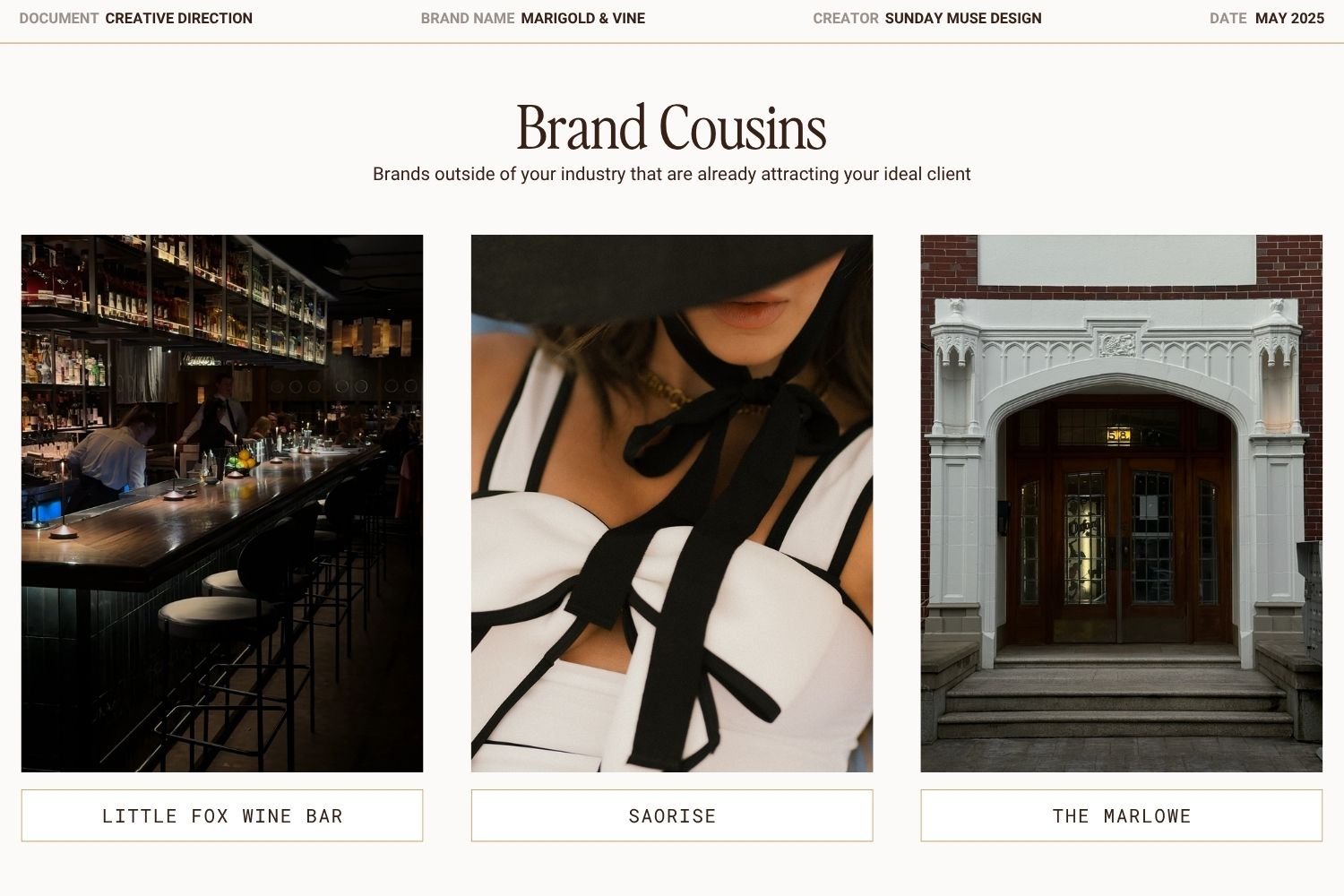
Get fifteen of them down. Then look at the pile and notice what they have in common. Notice the feeling first, before anything visual. Maybe they're all warm and a little irreverent. Maybe they're all calm and confident. Maybe they're all big and joyful and a bit much in the best way. Whatever that shared feeling is, that's your thread. It's the direction your brand's been missing. Your competitors don't have it, because they're all still staring at each other.
A couple of honest warnings, because I'd rather you do this well than do it fast. Pick cousins your client genuinely loves. Not the brands you think are cool. This is about her, not your Pinterest board. And pull from the feeling and the values, never the literal logo. The point was never to look like a wine bar. The point was to take the wine bar's confidence and put it into something that's clearly, only yours.
One more thing. This gives you a direction. It doesn't hand you a finished brand. The cousins point you somewhere. Then turning that into real colors and type and a brand that works is its own whole craft. And it's the part I'd argue you really shouldn't hand to a template or to AI. A real creative call looks forward, at who you're becoming. AI can only look backward, at what already exists. And backward is the exact sea of sameness you're trying to get out of.
You Built Something Worth Seeing
You took your brand seriously enough to study your field. And your field studied you right back into the middle of the pack. That's how the sameness happened. You did everything you were told to do.
You've already grown the business. The clients are there, the work is good, the momentum is yours. The only thing missing is a brand specific enough to keep up with it all. One that looks like you actually decided how it should feel. Not a look you caught from a bunch of people who were just as unsure as you were.
So before you swap your palette one more time, swap your reference. Look at what your dream client already loves. Build from there. The version of your brand that finally stands out has been hiding in her taste this whole time.
And if you'd rather not do that part alone, that's what I do. I find the thread in it all and build the brand that fits the business you've grown. You'll get a brand as good as the business behind it.