What Working With Sunday Muse Design Feels Like
The stuff that doesn’t fit in a process doc.
A client told me recently that filling out my questionnaire made her cry a little.
Not in a bad way. In a “oh, someone is finally asking the right questions” way. In a “I’ve been trying to articulate this for two years and apparently all I needed was someone to ask it directly” way.
Hi, Kelly. That was you. Hope you don’t mind that I’m telling this story.
That moment stuck with me because it said something true about what this work is—and what it isn’t. It’s not a polished handoff of strategy documents. It’s not me disappearing for three weeks and coming back with a PDF you’ll open twice. Whatever Kelly felt isn’t something that fits neatly into a deliverables list, which is why I’m writing this instead.
I’ve already got posts that cover what the Brand Strategy Intensive includesand what happens after you become a client. This is the in-between. The texture of the thing.
I collect the way you talk about your own business.
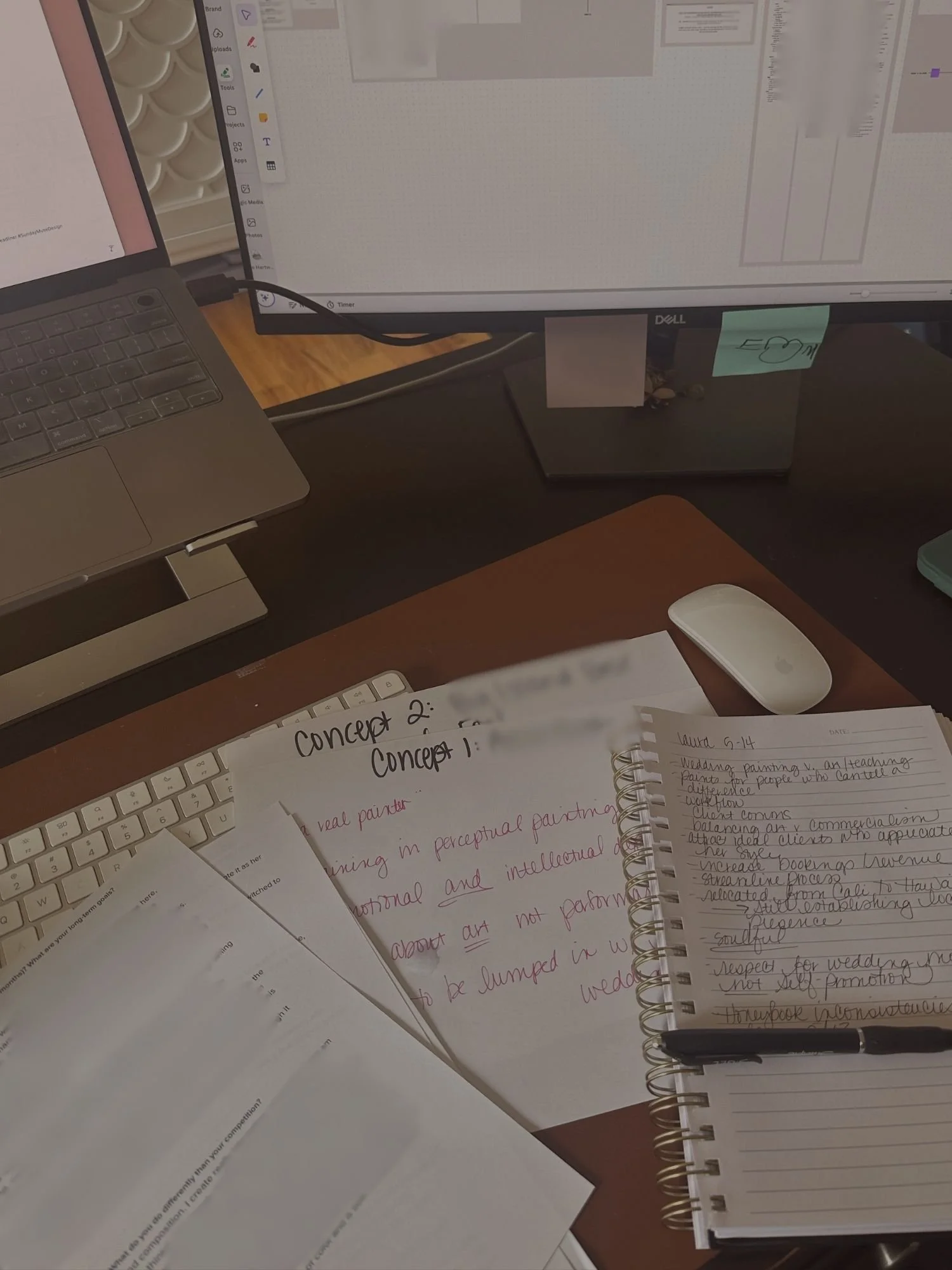
I keep a document called the Client Language Bank. Every time a client says something that lands—the exact phrase that names a frustration I’ve heard a hundred times but never quite that way—I write it down. “My brand feels like wearing clothes from three years ago.” “Something’s off and I can’t name it.” “I cringe a little every time I send someone to my website.”
I started doing this because I noticed early on that my clients described their situations more accurately than I ever could from the outside. And if I wanted the work to land—not just be strategically sound, but felt—I needed to use their words, not mine.
So when you send me an inquiry, I’m not skimming it for timeline and budget. I’m reading it for language. For what you’re circling around. For the thing you almost said and then softened. That attention starts before we’ve ever gotten on a call.
The research phase is where I become a little obsessive (In a useful way)
When I say I’m going into research mode, I think clients picture me running a few tools and taking notes. What happens looks more like: 31 browser tabs, several hours of reading I find genuinely fascinating, and my husband walking in mid-competitor-analysis to find me taking notes on a stranger’s Google reviews like it’s the most important document I’ve ever touched.
(He closed the door and left. Smart man.)
I’m reading your competitors’ client reviews (all of them… the frustrated ones, the effusively grateful ones) because people say in reviews what they couldn’t bring themselves to put in an email. I’m looking at the language your ideal clients use when they’re searching for someone like you at 2am, when they’re not performing. I’m finding the gap in your market that nobody’s filling, and that you probably can’t see from inside your own business because you’re too busy running it.
None of this goes through AI. It’s me reading, for several hours, because that’s the only way to find it.
One client called what I brought back “the first time someone came back with receipts.” I wrote that one down immediately.

I’ll say the thing you didn’t ask me to say.
Ten years of teaching writing and rhetoric left me with one very specific habit: I cannot watch someone work around a problem without naming it.
If the research turns up something that complicates the direction you came in wanting, I’m going to bring it up. If there’s friction in your positioning that’s been costing you, I’m going to name it clearly—and without making you feel bad about not having caught it yourself. If I think a different approach would serve you better, I’ll say so directly, and then we’ll figure out together whether I’m right.
The women I work with are good at what they do. They’ve built something real and they know it. Their brand has just stopped keeping pace with where they’ve grown, and they want a clear, honest read on what’s there and a direct path forward.
Clients sometimes say they didn’t realize how much they wanted someone to just be direct with them until it happened.
That one’s in the Language Bank too.
The strategy session is a working session. We build it together.
There’s a version of strategy work where the strategist disappears for a few weeks and comes back with a finished document and says “here’s your brand.” I understand the appeal—it feels efficient. What it tends to produce, in my experience, is a beautiful PDF that lives on a desktop forever, because the client doesn’t feel it, doesn’t fully understand it, and wasn’t part of building it.
The Workshop is where we build your brand narrative together, in real time. I bring what the research is pointing toward. You tell me whether it feels true. We push on the parts that don’t quite fit until they do.
This is my favorite part of the process, for what it’s worth. (Designers are supposed to say the design reveal is the best part. I’m a strategy nerd. The Workshop wins for me every time.)
What comes out of it is a strategy you co-authored—which means you understand it well enough to explain it to your copywriter, your VA, a new designer, anyone—without reading from a 38-page deck first.
You’ll leave knowing more about your business than when you arrived.
This is the part clients come back to mention months later, and the part I’m most proud of.
The deliverables are useful—the one-page strategy, the 90-day roadmap, the brand guidelines. Those matter, yes. But what I keep hearing about is harder to put on a sales page: a confidence in their own positioning that wasn’t there before. The ability to make a brand decision quickly because there’s a filter now. The I finally know how to talk about what I do feeling that clients had been hoping for and weren’t sure they’d get.
One of my favorite messages to receive is someone saying they pulled out their one-pager six months after the project closed and it still held true. That’s what I’m building toward every time…something that works when I’m not in the room.
If you want the step-by-step, those posts are here: what the Brand Strategy Intensive includes and what happens after you become a client.When you’re ready to talk about your brand, the inquiry formis where it starts.