
"Something's Off" Is Enough: What to Do When You Can't Explain What's Wrong With Your Brand
I keep a note in my phone of things people say in the first ten minutes of a call.
"I'm bored."
"Something's off."
"It's fine, I guess."
"I don't hate it." (that one was last month)
Then comes an apology, every single time, usually some version of “I know that's not helpful.”
I promise you it's helpful. It's the most useful thing you can bring me, and you already have it.
The newest one in that note is a lawyer who's ten years in, with a practice that's doing well by every number she can point at. She stopped mid-sentence to apologize for being vague, and I told her what I'm about to tell you: she'd already done her part. Knowing something's wrong is the qualification. Describing it is my job.
She'd been sitting on that feeling for two years, waiting to be able to explain it before she asked anyone for help.
Why Business Owners Sit on "Something's Off" for Years
There's a belief running underneath this that I run into constantly, and I don't think anyone says it out loud, which is why it never gets corrected.
The belief is that you need to show up with a diagnosis. That before you're allowed to hire someone or even book a call, you should be able to produce a tidy sentence explaining what's broken. Otherwise you're wasting everyone's time and you'll look like you don't know your own business.
That belief costs people years.
Nobody applies it anywhere else, or at least nobody applies it this strictly. Your shoulder hurts when you reach for things, so you ask Google, then you ask ChatGPT, then you go back to Google with better words, and by 9pm you've got four possible conditions and a bad attitude about your own rotator cuff.
Then you go to the doctor anyway. And she doesn't ask for your research. She asks where it hurts and when it started, and takes it from there.
You'd think it was strange if the front desk turned you away for failing to arrive with an imaging report.
Somewhere along the way, "I feel like something's wrong with my brand" started feeling like it needed more homework attached to it. It doesn't.
What "Off" Usually Turns Out to Mean
Here's the part that might be a relief: "off" is not as vague as it feels from the inside. It's vague to you because you've been alone in it. From the outside, it's a fairly short list of things.
Most of the time it comes down to one of these:
Your business grew and your brand stayed where it was.
Your site is showing everything you do instead of the work you want more of.
It's nice. It's fine. It doesn't make a case for you over the four other people she's looking at.
You built it for a client you don't want anymore.
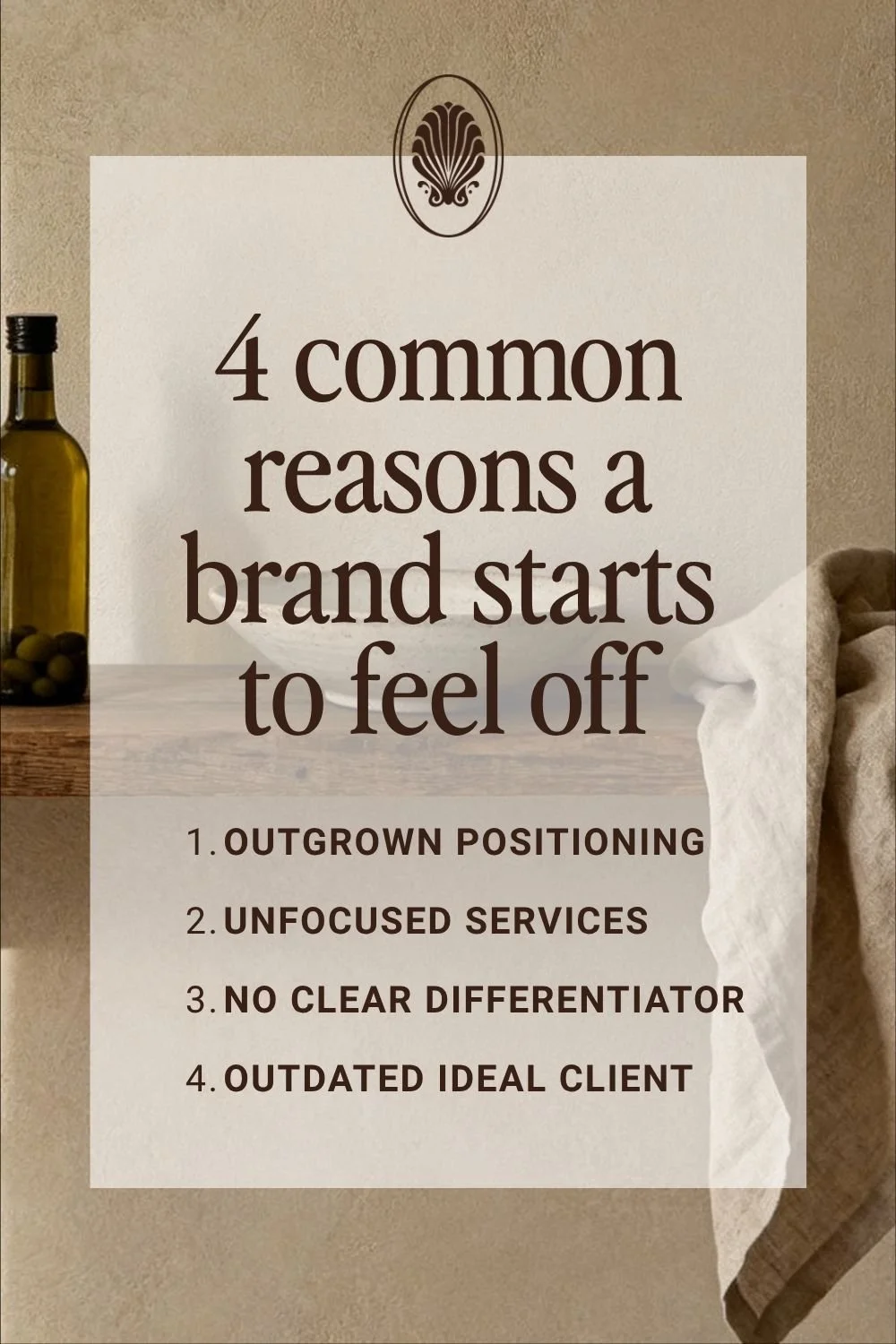
None of those feel like anything from where you're sitting. They all feel like a slow, low-grade sense that you don't love it anymore. (I wrote a whole post on what a brand audit turns up if you want see the specific things I go looking for)
A wedding photographer told me she'd been saying the same three things to herself for years: It's fine. I'm still booking. I'll fix it later.
Then she said the part that gets me. Deep down, she knew it wasn't fine. Her instinct was right the whole time. What she didn't have was language for it, so every few months she talked herself back out of it and got on with the season.
Her real problem, once we got in there, was that her website had stopped reflecting half of what she was photographing and almost none of what she wanted to be photographing. She could fix that. We got there in about forty minutes, and she'd been living with the feeling for three years.
Why Being Bored With Your Own Brand Is Worth Taking Seriously
Boredom sounds like a vanity complaint, so it always comes out with an apology attached. "I know this is silly, but I'm just kind of over it."
Please stop apologizing for that one. Boredom is usually the earliest signal you get that the business moved and the brand stayed home.
Your brand was right once. Low-rise jeans were right once. Time does what time does, and the genuinely annoying part is that no notification goes out when it happens. There's no alert that says the business you're running is no longer the business on your website. There's just a slow feeling in your chest on a Tuesday.
Think about the last three years. You raised your rates twice. You said yes to a kind of project you'd have turned down in 2022 and it turned into the best thing you did all year. You developed opinions. Your About page did none of that. It's still written by a woman charging a third of what you charge now, and she was thrilled about it. Bless her.
So when you look at your own site and feel bored, what you're feeling is distance between where the business is and where the brand thinks it is.
Being Bored Doesn't Mean You Need a Full Rebrand
This is where I want to be careful, because I run a branding studio and there's an obvious version of this post where every road leads to hiring me for the biggest thing I sell.
So I'll be straight with you. A lot of my strategy clients do end up rebranding. Most of them, if I'm counting honestly.
The difference is that by the time they get there, they know exactly why, and so do I. They’re building something they can grow into instead of something they’ll redo in eighteen months. They've seen what's mismatched, they know which pieces are worth keeping, and they can tell you what the redesign is supposed to fix. That's a very different purchase than deciding at 11pm that you hate your logo.
And some of them don't rebrand at all. Sometimes the answer is that your services page is in the wrong order and the offer you want more of is sitting at the bottom of it. Sometimes you're using a word your clients don't use. Sometimes you need to retire an offer you've been dragging around out of guilt, and the whole brand feels different by Friday.
I've told people their identity is fine and something else is entirely the problem. I've told people to change one sentence in their header and check back with me in six months.
Boredom is a reason to look. It isn't automatically a reason to spend thousands on design, and you shouldn't have to guess which one you're dealing with before you're allowed to ask.
What It Costs to Wait Until You Can Explain It
The reason I don't want you sitting on this for two more years is that the feeling isn't free while you wait.
A photographer I worked with lost a job over one word. The client called her work too "baby." She'd moved on from that kind of shooting years earlier, and her website never got the memo, so the client did what any of us would do and described what was in front of her. That word cost her the booking, and it's what finally made her fill out my contact form.
Sit down with how unfair that is for a second. She'd done all the growing. She changed what she shot, who she shot it for, how much she charged, the whole thing. The only piece that hadn't moved was the one piece a stranger could see.
An event planner told me she knew exactly what she didn't like about her own branding and voice, and that was the entire list. What she could see clearly was that a client could set her next to three other planners, compare all four side by side, and find nothing on the page making the case for her. She was losing clients to that comparison and she knew it while it was happening.
A wedding photographer described the cost in three ways: misaligned inquiries, hours in conversations that were never going anywhere, and the clients she'll never know she lost.
That last one is the one that hurts the most. There's a number of people who looked at your site, decided you weren't for them, and closed the tab. You'll never meet a single one of them.
I'm not telling you that so you spiral about it at midnight. I'm telling you because out of everything happening in your business right now, it's one of the most fixable numbers you've got.
She said it was costing her time, energy, and confidence. Confidence is the one I keep thinking about.
How I Get From "Something's Off" to Something Specific
You've never watched a stranger move through your site. You've read your own About page so many times it stopped being words. Ten years in, and it's still hard to know what a client needs to see before she books, because you've only ever been on your side of the screen.
That's the whole reason describing it is hard, and it's the thing I'm hired for.
So we start with a Discovery Workshop, which is a long conversation about the business you're running now and the one you're building toward. You don't prepare anything. You show up with the feeling.
Then I go away and look at your business the way a potential client would. I read your site cold, look at what you're up against in your market, go through your inquiries with you, and find where what you're saying and what you're delivering have come apart. That outside view is the one thing you structurally cannot get on your own, no matter how good you are at your job.
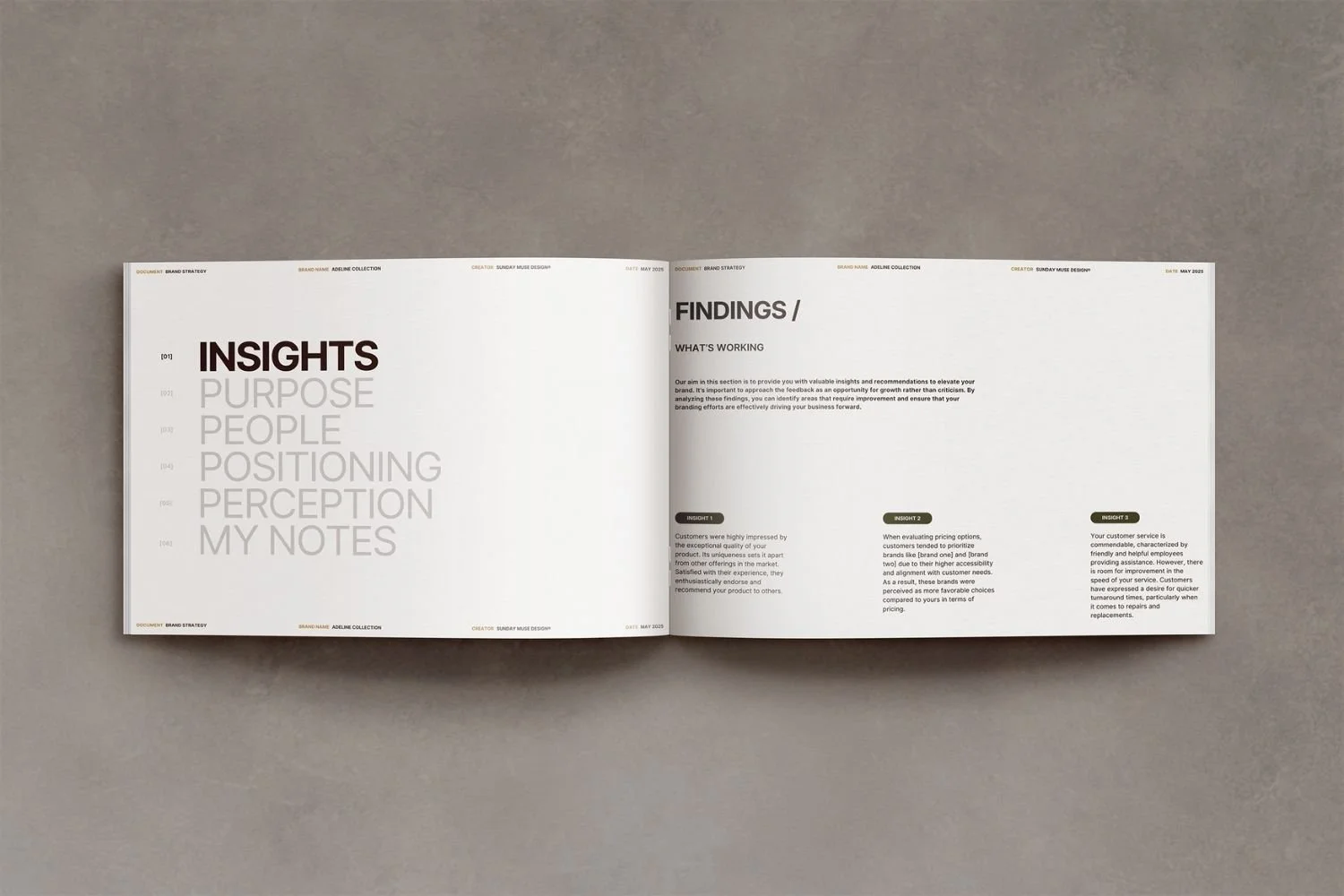
Then we sit down for a Co-Create Session and build the strategy together, out loud, so you understand every decision in it and know how to use it after I'm gone. Here’s what that looked like for an interior designer, start to finish.
You leave with a one-page Brand Strategy and a 90-Day Roadmap that tells you what to change, in what order, and what to leave alone. Sometimes that roadmap says redesign the website. Sometimes it says fix these three sentences and go book more of what you like doing.
What Changes When Someone Else Can See It
The first thing you notice is speed. Decisions that used to take three months take an afternoon, because you finally have something to measure them against.
You stop editing your homepage at 11pm. You can hand a designer one sentence and watch it do more than a mood board with forty screenshots in it. You can tell whether a change worked, because you know what it was supposed to do in the first place.
You also get your Sunday nights back, which nobody puts on a sales page, and which I'd argue is most of the point.
And when someone asks what you do at a dinner party, the answer comes out sounding like the business you're running now.
If You've Been Sitting in "Something's Off" for a While
Good businesses get passed over every day because their brand can't say what they've built. You built the thing. Nobody's asking you to redo it.
Sunday Strategy is the three-week intensive I built for this exact moment. It's for the woman whose business is doing well, who knows something stopped fitting a while back, and who'd like somebody else in the room before she spends real money on design she may not even need.
If you decide to move forward with a design project shortly after we wrap, your investment credits toward it.
One last thing, because I know how the objection sounds from the inside. If your version of this is I'm not ready yet, not being able to explain the problem is the reason to come, not the reason to wait. Bring me the vague version. That's the whole ask.